







⏱️ 7 min read
Top 10 Weirdest Art Installations in the World
Contemporary art has long pushed the boundaries of what society considers acceptable, beautiful, or even comprehensible. Throughout history, artists have challenged viewers to expand their perspectives and question their assumptions about the world around them. Art installations, in particular, have become a medium through which creators can express their most unconventional ideas, transforming spaces and experiences in ways that range from thought-provoking to downright bizarre. The following ten installations represent some of the strangest artistic endeavors ever conceived, each leaving audiences bewildered, amazed, and questioning the very nature of art itself.
1. "The Cloud Gate" by Anish Kapoor - Chicago, USA
While Chicago's famous "Bean" might seem tame compared to other entries on this list, its surreal reflective properties and unusual shape make it one of the world's most peculiar public installations. Weighing 110 tons and covered in highly polished stainless steel plates, this kidney-bean-shaped sculpture distorts the Chicago skyline and the faces of visitors in bizarre and often comical ways. The seamless construction required precision welding and polishing, creating a mirror-like surface that transforms the urban landscape into an otherworldly dreamscape. What makes it particularly weird is how it turns viewers into unwitting participants in the artwork, their distorted reflections becoming part of the installation itself.
2. "The Museum of Non-Visible Art" by Brainard and Delia Carey - New York, USA
Perhaps the ultimate commentary on contemporary art's relationship with commerce, this installation consists entirely of nothing. The museum sells pieces that don't physically exist, providing only title cards and descriptions of imaginary artworks. In 2011, a woman paid $10,000 for a piece titled "Fresh Air," receiving only a written description and the artist's guarantee that the work exists in the conceptual realm. This installation forces viewers to confront the question of whether art must be visible to be valuable, and whether the concept alone can constitute artistic expression. It remains one of the most controversial and philosophically challenging installations in recent memory.
3. "Cloaca" by Wim Delvoye - Various Locations
Belgian artist Wim Delvoye created what might be art's most literal interpretation of digestive processes: a machine that eats food and produces excrement. The installation consists of a complex system of glass containers, pumps, and vessels that mechanically reproduce human digestion. Visitors can watch as the machine is "fed" gourmet meals, which are then processed through various chambers containing acids and bacteria, eventually producing waste that is indistinguishable from human feces. The installation raises uncomfortable questions about consumption, waste, and the bodily processes society prefers to ignore, all while functioning as a perfect metaphor for modern consumerism.
4. "My Bed" by Tracey Emin - London, England
This controversial installation featured the artist's actual unmade bed, surrounded by debris from a particularly difficult period in her life, including used condoms, stained sheets, cigarette butts, and empty vodka bottles. First exhibited in 1998 as part of her Turner Prize nomination, the work transformed something deeply personal and intimate into a public spectacle. Critics debated whether displaying one's messy bedroom constituted art or mere exhibitionism. The installation sold for £2.5 million in 2014, cementing its place in art history despite its decidedly unglamorous subject matter.
5. "The Heidelberg Project" by Tyree Guyton - Detroit, USA
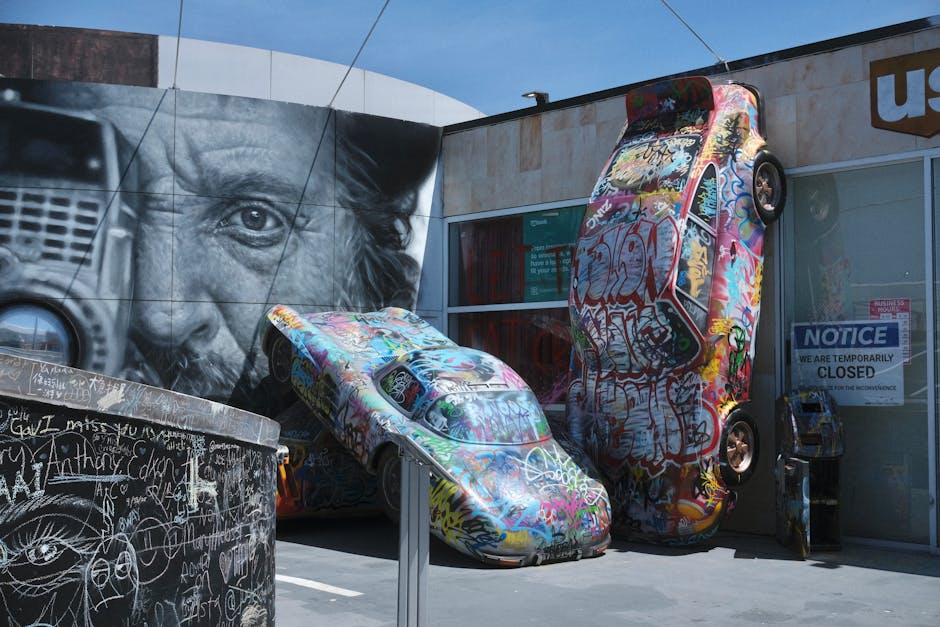
What began as one artist's response to urban decay has become an ever-evolving outdoor installation that transforms entire city blocks into a kaleidoscopic wonderland of found objects. Abandoned houses are covered in polka dots, stuffed animals are nailed to walls, discarded shoes dangle from trees, and shopping carts are arranged in seemingly random patterns. The installation uses Detroit's urban blight as its canvas, turning neighborhoods that might otherwise be forgotten into destinations for art lovers worldwide. Its weirdness lies in its scale and its use of trash and abandoned buildings as primary artistic materials.
6. "The Maman Spider" by Louise Bourgeois - Various Locations Worldwide
Standing over 30 feet tall, this bronze, stainless steel, and marble sculpture depicts a spider carrying 26 marble eggs in its sac. The massive arachnid installations appear in cities around the world, creating an unsettling presence wherever they're displayed. Bourgeois created the spider as a tribute to her mother, who was a weaver, but the towering creature evokes both protection and predation. The scale and subject matter combine to create an installation that's simultaneously maternal and monstrous, beautiful and terrifying.
7. "Artist's Shit" by Piero Manzoni - Various Collections
In 1961, Italian artist Piero Manzoni produced 90 tin cans, each allegedly containing 30 grams of his own feces. The cans were labeled in Italian, English, French, and German, and sold for their weight in gold. This installation challenges notions of artistic value and authenticity, as no one can verify the contents without destroying the artwork. Several cans have sold at auction for significantly more than their weight in gold, making this potentially the art world's most expensive excrement. Whether the cans actually contain what they claim remains uncertain, adding another layer of absurdity to this bizarre creation.
8. "The Gates" by Christo and Jeanne-Claude - New York, USA
For 16 days in 2005, Central Park was transformed by 7,503 saffron-colored fabric panels suspended from vinyl gates along the park's pathways. The temporary installation created an undulating ribbon of color that stretched for 23 miles, fundamentally altering how millions of New Yorkers and visitors experienced the park. The sheer scale of the project, combined with its temporary nature and the estimated $21 million cost borne entirely by the artists, made it one of the most ambitious and peculiar installations ever attempted. The gates served no practical purpose and existed purely as an aesthetic intervention in public space.
9. "Rain Room" by Random International - Various Locations
This installation creates a field of falling water that miraculously stops wherever visitors walk, allowing people to move through a downpour without getting wet. Motion sensors detect human presence and create a dry zone around each person, producing the surreal experience of standing in the middle of a rainstorm while remaining completely dry. The installation plays with natural phenomena and human perception, creating an impossible scenario that challenges our understanding of how the world works. Its weirdness lies not in shock value but in its ability to make the impossible seem real.
10. "The Tilted House" by Dan Havel and Dean Ruck - Houston, USA
For this installation, artists Dan Havel and Dean Ruck transformed two condemned houses into a massive vortex, peeling back the exterior siding and creating a spiraling tunnel that appeared to disappear into nothingness. Viewers could walk through the houses and witness the increasingly tight spiral of boards as they converged toward a vanishing point. The installation played with perspective, architecture, and the concept of demolition as creation. By deconstructing the houses in such a deliberate and artistic way, the artists turned scheduled destruction into a meditation on space, form, and the passage of time.
Conclusion
These ten installations represent the outer limits of artistic expression, where conventional beauty and traditional aesthetics give way to concepts that challenge, provoke, and disturb. From invisible artworks to mechanical digestive systems, from giant spiders to artist's excrement, these creations force viewers to reconsider what art can be and what purposes it can serve. Whether celebrating them as brilliant commentary on modern life or dismissing them as pretentious nonsense, audiences cannot ignore these installations. They occupy a unique space in cultural conversation, reminding us that art's primary purpose may not be to comfort or please, but to make us think, feel, and question our assumptions about the world and our place within it. These weird and wonderful installations ensure that contemporary art remains a vital, unpredictable force in global culture.