
⏱️ 7 min read
Top 10 Most Influential Leaders of All Time
Throughout human history, certain individuals have emerged whose leadership transcended their own lifetimes, fundamentally reshaping civilizations, ideologies, and the course of human events. These leaders possessed extraordinary vision, charisma, and the ability to mobilize masses toward transformative change. Whether through military conquest, spiritual guidance, political revolution, or social reform, their legacies continue to influence billions of people today. This article examines ten of the most influential leaders whose impact on world history remains undeniable and whose lessons in leadership continue to resonate across centuries.
1. Alexander the Great (356-323 BCE)
Alexander III of Macedon created one of the largest empires in ancient history, stretching from Greece to India, before his death at age 32. His military genius revolutionized warfare through innovative tactics and strategic brilliance that are still studied in military academies worldwide. Beyond conquest, Alexander spread Hellenistic culture across three continents, facilitating unprecedented cultural exchange between East and West. He founded over twenty cities, most notably Alexandria in Egypt, which became centers of learning and commerce. His vision of cultural fusion, demonstrated by adopting Persian customs and encouraging intermarriage between Greeks and Persians, set a precedent for cosmopolitan leadership that transcended narrow ethnic boundaries.
2. Julius Caesar (100-44 BCE)
Gaius Julius Caesar transformed the Roman Republic into the foundation of the Roman Empire, forever altering Western civilization’s trajectory. His military campaigns in Gaul expanded Roman territory dramatically, while his political acumen and reforms addressed systemic problems in Roman governance. Caesar’s crossing of the Rubicon River became synonymous with passing the point of no return, demonstrating decisive leadership in critical moments. His administrative innovations, including calendar reform that gave us the Julian calendar, influenced daily life for millennia. Though assassinated by senators fearing his power, Caesar’s legacy lived on through his adopted heir Augustus, who completed the transformation to imperial rule that shaped European history for centuries.
3. Genghis Khan (1162-1227)
Born Temüjin, Genghis Khan united the Mongol tribes and established the largest contiguous land empire in history, stretching from Eastern Europe to the Sea of Japan. His meritocratic military organization, innovative communication systems, and religious tolerance were revolutionary for his era. The Mongol Empire facilitated the Silk Road’s golden age, enabling unprecedented trade and cultural exchange between East and West. Genghis Khan’s legal code, the Yassa, established rule of law across diverse populations. While his conquests were brutal, resulting in millions of deaths, his empire’s administrative systems and promotion based on ability rather than birth status influenced governance structures across Asia for generations.
4. Napoleon Bonaparte (1769-1821)
Napoleon rose from relatively modest Corsican origins to become Emperor of France and dominate European affairs for over a decade. His military genius produced victories against seemingly impossible odds, and his Napoleonic Code reformed legal systems across Europe and beyond, establishing principles of civil law still used in many countries today. Napoleon’s administrative reforms modernized France’s educational system, infrastructure, and government bureaucracy. His conquests spread Enlightenment ideals of nationalism and republicanism across Europe, inadvertently fueling movements that would reshape the continent throughout the nineteenth century. Though ultimately defeated, Napoleon’s impact on military strategy, law, and European political development proved irreversible.
5. Mahatma Gandhi (1869-1948)
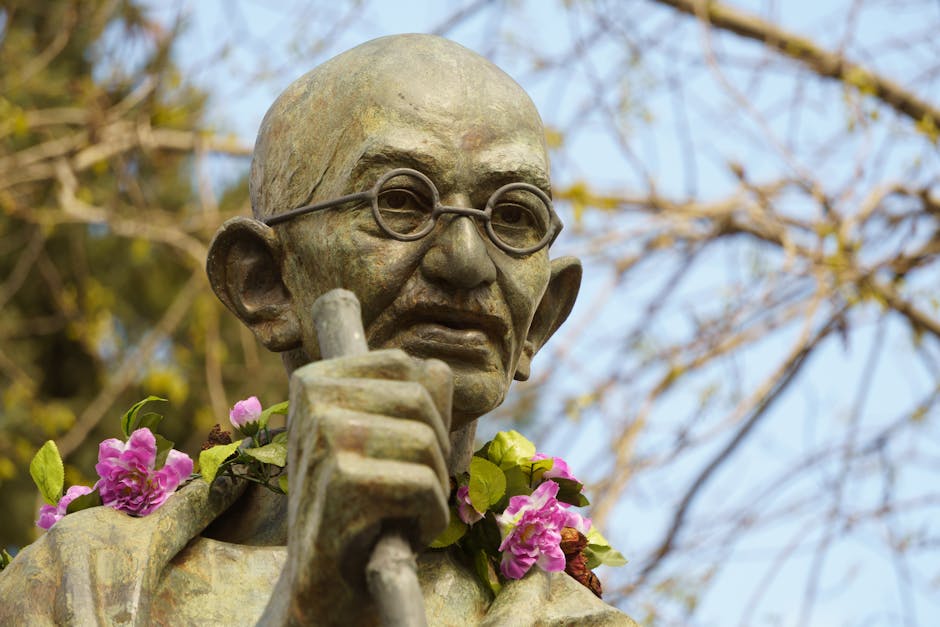
Mohandas Karamchand Gandhi pioneered nonviolent resistance as a powerful tool for political and social change, leading India to independence from British colonial rule. His philosophy of Satyagraha, or “truth force,” demonstrated that moral authority could triumph over military might. Gandhi’s methods inspired civil rights movements worldwide, directly influencing leaders like Martin Luther King Jr. and Nelson Mandela. His emphasis on self-reliance, exemplified by the symbolic spinning wheel, promoted economic independence alongside political freedom. Gandhi’s vision extended beyond Indian independence to encompass interfaith harmony, social justice, and the upliftment of the untouchable caste, making him a universal symbol of peaceful resistance to oppression.
6. Winston Churchill (1874-1965)
Winston Churchill’s leadership as British Prime Minister during World War II proved instrumental in defeating Nazi Germany and preserving democracy in Europe. His stirring oratory rallied the British people during their darkest hour, when invasion seemed imminent and defeat appeared inevitable. Churchill’s strategic vision helped forge the Allied coalition, and his personal relationship with Franklin D. Roosevelt proved crucial to securing American support. Beyond wartime leadership, Churchill was a prolific writer and historian whose works shaped historical understanding of both World Wars. His warnings about Soviet expansion and his “Iron Curtain” speech helped define the Cold War era, demonstrating prescient understanding of geopolitical realities.
7. Nelson Mandela (1918-2013)
Nelson Mandela emerged from twenty-seven years of imprisonment to lead South Africa’s peaceful transition from apartheid to multi-racial democracy, becoming the nation’s first Black president. His extraordinary capacity for forgiveness and reconciliation prevented the civil war many predicted, instead establishing the Truth and Reconciliation Commission to address past injustices while building a unified future. Mandela’s moral authority made him a global symbol of human dignity and the struggle against oppression. His leadership demonstrated that principled resistance combined with magnanimity toward former enemies could achieve transformative social change. Mandela’s legacy extends far beyond South Africa, inspiring movements for justice, equality, and human rights worldwide.
8. Abraham Lincoln (1809-1865)
Abraham Lincoln preserved the United States during its greatest crisis, the Civil War, while simultaneously ending the institution of slavery through the Emancipation Proclamation and supporting the Thirteenth Amendment. His leadership transformed America from a nation divided over slavery into one committed, at least constitutionally, to equality before the law. Lincoln’s speeches, particularly the Gettysburg Address, redefined American democracy in terms of equality and human dignity. His political skill in managing competing factions and his strategic patience in timing the Emancipation Proclamation demonstrated sophisticated leadership under extreme pressure. Lincoln’s assassination made him a martyr for the causes of union and freedom, cementing his status as perhaps America’s greatest president.
9. George Washington (1732-1799)
George Washington led the Continental Army to victory in the American Revolution against the world’s most powerful military, then presided over the Constitutional Convention that created the United States government. His decision to voluntarily relinquish power after two presidential terms established the precedent for peaceful democratic transition, a radical departure from historical norms where leaders clung to power. Washington’s Farewell Address warned against partisan division and foreign entanglements, advice that influenced American policy for generations. His character and integrity made the American experiment in republican government credible when most of the world remained under monarchical rule. Washington’s leadership model emphasized civic virtue, self-restraint, and service above personal ambition.
10. Muhammad (570-632 CE)
The Prophet Muhammad founded Islam, now the world’s second-largest religion with over 1.8 billion followers, and established a political and social order that transformed Arabia and spread across three continents within a century of his death. Muhammad unified the fractious Arabian tribes under a common religious and political framework, establishing principles of social justice, charity, and monotheistic worship. The Quran, which Muslims believe was revealed to Muhammad, became the foundation for Islamic law, culture, and civilization. Beyond religious leadership, Muhammad was a statesman, military commander, and social reformer who elevated women’s rights and established principles of economic justice for his time. His influence on world history through Islam’s impact on art, science, philosophy, law, and politics across Asia, Africa, and Europe cannot be overstated.
Conclusion
These ten leaders represent diverse cultures, eras, and leadership styles, yet they share common traits: extraordinary vision, the ability to inspire others, courage in facing seemingly insurmountable challenges, and lasting impact that extended far beyond their lifetimes. From Alexander’s cultural fusion to Gandhi’s nonviolent resistance, from Washington’s voluntary relinquishment of power to Mandela’s reconciliation, each demonstrated that leadership at its highest level transcends mere political or military success to address fundamental questions of human organization, justice, and dignity. Their legacies, both inspiring and cautionary, continue to shape our modern world and offer timeless lessons about the power of principled, visionary leadership to change the course of history. Understanding their achievements and failures provides invaluable perspective on contemporary challenges and the enduring qualities that define truly transformative leadership.
