
⏱️ 7 min read
Top 10 Fascinating Facts About the Solar System
The solar system, our cosmic neighborhood in the vastness of space, continues to captivate scientists and stargazers alike with its remarkable mysteries and wonders. From the scorching surface of Mercury to the icy reaches beyond Neptune, our solar system is home to phenomena that challenge our understanding of physics, geology, and the very nature of planetary formation. These ten fascinating facts reveal just how extraordinary our celestial home truly is, offering insights into the dynamic and sometimes bizarre characteristics that make our solar system unique in the known universe.
1. The Sun Contains 99.86% of the Solar System’s Mass
The sheer dominance of the Sun in our solar system is staggering. This massive star accounts for approximately 99.86% of all the mass in the entire solar system. Despite the presence of eight planets, hundreds of moons, countless asteroids, comets, and other celestial bodies, they collectively represent less than 0.14% of the total mass. The Sun’s enormous gravitational pull, a result of its tremendous mass, is what keeps all these objects in their respective orbits. To put this in perspective, the Sun could fit approximately 1.3 million Earths inside its volume, demonstrating the enormous scale difference between our home planet and the star that gives us life.
2. Venus Rotates Backwards Compared to Most Planets
Venus exhibits one of the solar system’s most peculiar characteristics: retrograde rotation. While most planets rotate counterclockwise when viewed from above the Sun’s north pole, Venus spins clockwise. This unusual rotation means that on Venus, the Sun rises in the west and sets in the east. Scientists believe this backward spin may have resulted from a massive collision with another celestial body billions of years ago. Additionally, Venus rotates so slowly that a single day on Venus (one complete rotation) takes longer than a Venusian year (one orbit around the Sun), making it the only planet in our solar system with this distinction.
3. Jupiter’s Great Red Spot Is a Storm Larger Than Earth
Jupiter’s Great Red Spot is a colossal anticyclonic storm that has been raging for at least 400 years, possibly much longer. This massive weather system is so large that it could easily swallow Earth whole, with a diameter that has historically measured up to three times Earth’s width. The storm’s distinctive reddish-brown color likely comes from complex chemical reactions involving the planet’s atmospheric gases and solar radiation. While recent observations have shown the Great Red Spot shrinking over the past century, it remains one of the most iconic and studied features in the solar system, offering valuable insights into atmospheric dynamics on gas giant planets.
4. Saturn Could Float in Water
If a bathtub large enough existed, Saturn would theoretically float in it. This gas giant has an average density of approximately 0.687 grams per cubic centimeter, which is less than water’s density of 1 gram per cubic centimeter. Saturn achieves this remarkably low density because it’s composed primarily of hydrogen and helium gases, with only a relatively small rocky core at its center. This unique characteristic makes Saturn the least dense planet in our solar system, despite being the second-largest planet by volume. The planet’s famous ring system, composed of ice particles and rock debris, adds to its spectacular appearance without significantly increasing its overall density.
5. A Day on Mercury Lasts Longer Than Its Year
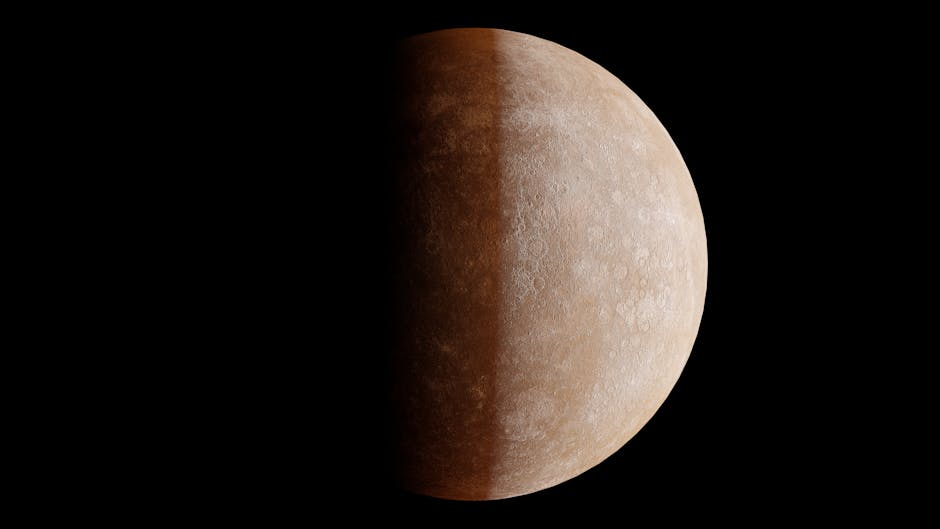
Mercury experiences one of the solar system’s most unusual day-night cycles. The planet completes one orbit around the Sun (a Mercurian year) in just 88 Earth days, but takes approximately 176 Earth days to complete one full rotation on its axis (a Mercurian day). This creates a bizarre situation where a single day-night cycle on Mercury spans two Mercurian years. The complex relationship between Mercury’s rotation and revolution, combined with its elliptical orbit, creates extreme temperature variations on the planet’s surface, ranging from approximately 430°C on the sun-facing side to -180°C on the dark side.
6. Olympus Mons on Mars Is the Tallest Mountain in the Solar System
Mars is home to Olympus Mons, a shield volcano that towers approximately 25 kilometers (16 miles) above the Martian surface, making it nearly three times the height of Mount Everest. This massive volcanic structure covers an area roughly the size of Arizona and formed over billions of years through successive lava flows. The lower gravity on Mars, about 38% of Earth’s gravity, allowed the volcano to grow to such tremendous heights without collapsing under its own weight. Olympus Mons is currently considered extinct, though scientists continue to study whether any geological activity might remain deep within the massive structure.
7. Neptune Has the Fastest Winds in the Solar System
Neptune, the eighth and outermost planet from the Sun, experiences the most violent winds in the solar system, with speeds reaching up to 2,100 kilometers per hour (1,300 miles per hour). These supersonic winds are particularly remarkable considering Neptune receives very little solar energy due to its distance from the Sun. Scientists believe the planet’s internal heat source drives these extreme atmospheric phenomena. The winds on Neptune blow in a direction opposite to the planet’s rotation, creating massive storm systems including the famous Great Dark Spot, a storm system similar to Jupiter’s Great Red Spot but which appears and disappears over time.
8. Earth Is the Only Planet Not Named After a God
While Mercury, Venus, Mars, Jupiter, Saturn, Uranus, and Neptune all derive their names from Roman and Greek deities, Earth stands alone with a name rooted in Germanic and Old English origins. The name “Earth” comes from the Anglo-Saxon word “erda,” meaning ground or soil. This naming convention reflects humanity’s historical perspective: while other celestial bodies were seen as divine or mythological entities in the heavens, our own planet was simply the ground beneath our feet. Interestingly, if Earth had been named following the mythological convention, it might have been called Terra, after the Roman goddess of the Earth.
9. The Asteroid Belt Contains Only 4% of the Moon’s Mass
Contrary to popular depictions in science fiction, the asteroid belt between Mars and Jupiter is not a densely packed field of rocks. The total mass of all objects in the asteroid belt combined is estimated to be only about 4% of our Moon’s mass. The asteroids are so widely distributed that spacecraft can traverse the belt with minimal risk of collision. This relatively sparse distribution challenges the theory that the asteroid belt represents the remains of a destroyed planet; instead, scientists believe it consists of primordial material that never coalesced into a planet due to Jupiter’s powerful gravitational influence disrupting the formation process.
10. Uranus Rotates on Its Side
Uranus has an axial tilt of approximately 98 degrees, meaning it essentially rotates on its side relative to the plane of the solar system. This extreme tilt causes the planet to experience the most unusual seasons in the solar system. During Uranian summer and winter, one pole points almost directly at the Sun while the other experiences total darkness, with each season lasting about 21 Earth years. Scientists theorize that this dramatic tilt resulted from one or more massive collisions with Earth-sized objects during the early formation of the solar system. This sideways rotation also affects the planet’s magnetic field, which is tilted significantly from the rotational axis and wobbles considerably as the planet rotates.
Conclusion
These ten fascinating facts merely scratch the surface of the wonders our solar system holds. From the Sun’s overwhelming dominance in mass to the peculiar rotations of Venus and Uranus, from the massive storms of Jupiter and Neptune to the geological marvels of Mars, our cosmic neighborhood continues to surprise and inspire. As technology advances and space exploration progresses, scientists continue uncovering new mysteries and refining our understanding of these celestial phenomena. The solar system remains a laboratory for understanding planetary formation, atmospheric science, and the fundamental forces that govern our universe, reminding us that even in our own backyard of space, there are countless discoveries yet to be made.
